Most people
will agree that practical experience is a good thing. In fact, if you’ve been
around the block a time or two, the old adage “experience is the best teacher”
is probably anchored in your mindset. When I reflect on my lessons learned
through practical experience I always find Will Rogers’ perspective insightful,
but also at times, troublesome: 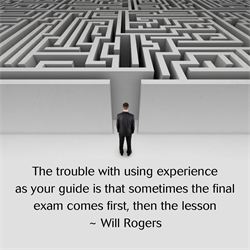 Why
troublesome? After all, at one point or another we all start out as greenhorns.
And let’s face it; there are situations we occasionally experience that are
really not possible to prepare for. What I find troublesome is the negative
impact on organizations when key executives continue to scoff at the lessons
offered, or worse, they refuse to acknowledge they were even handed an exam. Are senior
executives in your organization still scoffing at social media? In today’s environment
your customer’s are testing your organizations ability to interact with them on
social platforms in the same way you communicate with them through email and
over the phone. In fact, you may have seen the following factoids in recent presentations:
And yet some of your peers are still
hesitant, or openly against implementing social media strategies in your
organization. I suspect some are hesitant because they are not personally using
social media, and if the truth were known, they’re still not concerned with
learning. Even so, it’s time to let go of the notion that social media is just
for kids and has no business value. In short, you don’t want the adage “you can’t teach an old dog new tricks”
to begin to be associated with your personal brand. Here are some brief
observations to share with your leadership peers that might motivate them to
sign up for a lesson or two. 1. Your words and actions are magnified
by your position.
Most of your actions will seem more important to your employees than you
intend; merely teasing about the use or value of social media on your part may
become dangerously distorted by your workers. It’s time for you to provide
executive level support for this engagement channel. Keep this in mind;it’s not about you, it’s about
your customers. If
your customers want to communicate through LinkedIn, Twitter and Facebook who
are you to stop them? 2. No need to boil the ocean. There are scores of social media
related platforms and applications, so don’t be afraid to narrow your focus
during your initial learning process. It’s too early to declare with authority
the platforms that will remain standing, those that will be absorbed, or the
ones that will fade away. For senior executives I would recommend focusing on
LinkedIn, Twitter, Google+ and Facebook, in that order. Sidebar applications
that help with efficiency and effectiveness (for example, TweetDeck or various
mobile applications) can wait. 3. You can’t learn to swim without
getting wet, so jump in.
If nothing else, just commit to spending 15 – 20 minutes per day learning the
ins and outs of a single platform. Once you develop a comfort level move to the
next platform or application. If you have a trusted friend or colleague who is
already social media savvy consider asking them to breakfast or out for a beer.
Use the opportunity to pick their mind on the platforms they like to use, and
how they strategically leverage those applications. If all else fails, hire
someone to help you with your social media education. Based on my teaching and
consulting background I obviously like that approach! However, you may want to start by making an
author happy and simply purchasing one of the many social media related
publications on the market. 4. The clock is ticking. We’ve moved from a time of mass
communications to one of masses of communicators; your customers are sharing
their experiences through Twitter, Facebook, YouTube and other platforms at a
rate that will continue to accelerate. As a result, social media should become
a part of every organizations risk management and customer engagement strategy.
That means the entire leadership team (CEO, CIO, CFO, CMO, Sales, Legal and HR)
will feel the impact. You know from experience that it always takes more time
than expected to secure cross functional support. So, it’s time to start
building bridges.  |
 |
|||||
 





|

|
 


CategoriesCMOConsumer Privacy Content Marketing Customer Experience Human Resources Leadership Learning Marketing Resource Management Personal Branding Public Relations Sales Process SEO Social Media Social Media Marketing Social Networking Social Selling Strategy Teamwork Word of Mouth Marketing |
|||
    |
|||||
