|
Alan See: Posted on Wednesday, February 04, 2015 12:04 PM
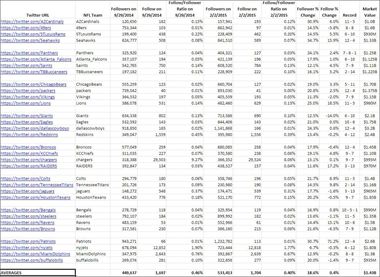
As you can see, the average NFL team was
following back just 0.46% of their fans in September. That ratio now stands at 0.40% which means the
average follow back strategy didn't change much over the season. Now that the Super Bowl is over I've taken
the time to update these statistics to see how the league performed in other
areas. |
|
|
Alan See: Posted on Saturday, January 31, 2015 3:24 PM
I’m where I am today because of the 1980’s
oil crash. If not for the oil crash I
may not have gone on to get my MBA. If
not for the crash I probably would not have ventured into the technology
industry, first with NCR Corporation and then other organizations. For that matter I may not have moved to Ohio.
I was from Iowa, in the heart of the
corn patch. But after completing my BBA
in 1981 from Abilene Christian University I could see that the West Texas oil
patch was booming. |
|
|
Alan See: Posted on Friday, January 30, 2015 5:03 PM
Are the targeted executives you are trying to get the attention of
using social media to shop, or are they really looking for prospects themselves? Perhaps both, with some education and
networking mixed in; I don’t have any market research to state a firm
conclusion. However; I do believe that
most executives are tuned-into station WIIFM (What’s in it for me?) just like
the rest of us, and they are seeking to promote their company and causes too. That’s why I find it interesting that so many
meeting requests contain the following leading sentences: |
|
|
Alan See: Posted on Wednesday, January 21, 2015 12:37 PM
It was a lively face-to-face business networking
event. As you might guess, social media was
a hot topic. Of course business cards
were exchanged as many of the attendees represented agencies that promise to be
able to bring social magic to a brand. But
what I found most interesting happened later, when I visited several of their
corporate social media pages. What
became clear was that many of the profiles had not posted content in several
weeks, and in some cases, months. |
|
|
Alan See: Posted on Tuesday, January 20, 2015 12:08 PM
I
penned “ Customer Intelligence Is Meaningless If You Don’t Tie It to Strategic
Action” many years ago.
Over time that article has been used by several organizations in their
training materials as a way of demonstrating the importance of customer service
and its impact on the customer experience.
One aspect of that article that is rarely commented on, but no less interesting, is the action I took related to
my search for a local service supplier when my incumbent vendor did not satisfy
my needs. |
|
|
Alan See: Posted on Friday, January 16, 2015 12:11 PM
WhenDilbertand his peers poke
fun at marketing trade show tactics they’re often referring to the use of “ booth babes.” Now, according to a recent Wall Street
Journal article (The
Evolution of Auto Show ‘Booth Babes’) it appears the auto-show model is coming back. I blogged on this topic in November 2007 ( Using
Marketing Booth Babes) and that post created a very spirited discussion. Usingsex to sellhas been a tactic
in advertising since its beginning. But
most of the audience (both men and women) who responded to my original post
clearly thought this practice had a great deal of downside risk. |
|
|
Alan See: Posted on Tuesday, December 30, 2014 10:41 AM
When was the last time you paid the full retail price? According to a recent article in The Wall
Street Journal (Attention,
‘Discount Junkies’) about 15% of shoppers generally pay full price for items
and don’t bother searching for sales. At
the other extreme, a fifth of online shoppers are considered true “discount
junkies,” people who make purchases only when offered discounts.
Discount shoppers are clearly reluctant to spend on premium
brands if value is missing. In fact, in
C. |
|
|
Alan See: Posted on Thursday, December 18, 2014 1:26 PM
Has
rational ignorance impacted your organizations social media activity yet? Rational ignoranceis the decision
not to become more informed about something because the perceived cost of the
additional intelligence in terms of both effort and expense is more than the
expected return on the knowledge gained.
It kicks in for most of us when we believe we have reached the point of
diminishing returns in relation to the value of acquiring additional insight. More than likely, your organization started
its social media journey with great excitement, and a willingness to invest and
learn; now most of your staff barely knows about the changes to the InMail policy
on LinkedIn, and it’s been weeks since they tweeted. |
|
|
Alan See: Posted on Tuesday, December 09, 2014 1:10 PM
Mistakes
were made. We've heard that before - many times. The phrase first made famous
by the Nixon administration was later used and re-used by many politicians -
Ronald Reagan, Bill Clinton, to name a few. People generally aren't fond of
admitting their mistakes. I'm not. Businesses are the same. They don't like to
talk about their mistakes certainly not publicly - but not even within company
walls. How mistakes are handled within a business says a lot about the people
who lead that organization. |
|
|
Alan See: Posted on Wednesday, December 03, 2014 9:26 AM
A recent article in the Wall Street
Journal (“Basic Costs Squeeze Families”) stated that consumers have seen little growth in
their wallets and remain skittish with discretionary spending. Of course, if you own a business that depends
on people having jobs and disposable income you didn’t need research from the
Bureau of Labor Statistics to tell you that consumer spending is sluggish. TheBlack Friday report card was underwhelming, and your calls and foot traffic are down. So, what’s your plan? |
|